
Parallel Compensation of Servo Systems
This example shows the simulation of a parallel compensated servo system using
QFIRE Studio
.Introduction
Parallel compensation in servo systems is usually implemented with a velocity feedback sensor and a proportional controller. Here, we use the
QFIRE CTR-101
as a digital controller and the plant model below (see [1]):In Figure 1, the inner loop is compensated by the
QFIRE
while the outer loop tracks the reference position signal.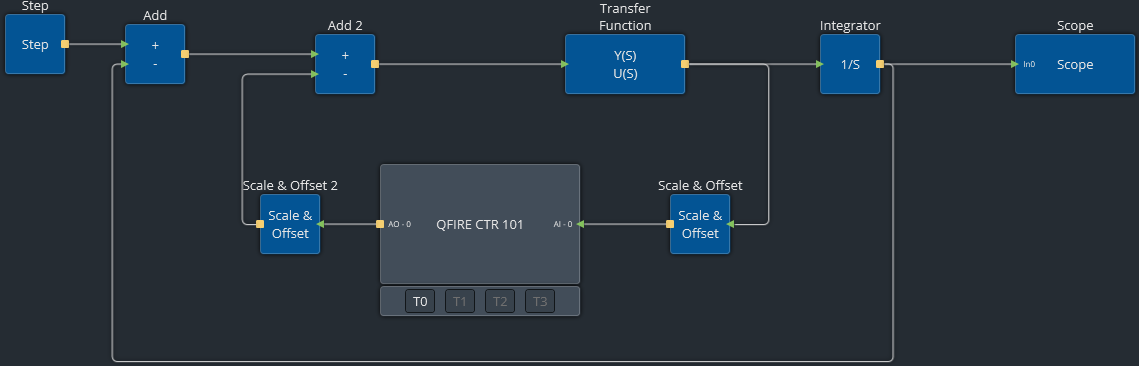
Figure 1 - Control System using
QFIRE CTR-101
as ControllerSimulation
The controller gain was determined as
QFIRE Studio
as the best fixed-point approximation supported byQFIRE CTR-101
. It sets the damping ratio of the dominant closed-loop poles to 0.4.A 1V offset scaling is required to fit the computed control signal in the expected range. Figure 2 shows all blocks used in the control task.

Figure 2 - P controller
Consequently, the scale correction outside the controller is performed by an amplifier circuit.
The step response of the position control system is shown in Figure 3.

Figure 3 - Unit-step response of the position control system using
QFIRE CTR-101
Bibliographic References
[1] - Katsuhiko Ogata,
Modern Control Engineering
, Fourth Edition, Delhi: Pearson, 2003.About MWF
MWF is a traditional Brazilian company that provides a wide range of electronic and mechatronic products for industry sectors such as automotive, agricultural machinery and aerospace.
Contact Us
Rua Doutor Siqueira, 139 / Sala 804 Campos dos Goytacazes - RJ, Brasil
contact@mwf-technologies.com
© 2018-2026 MWF. All rights reserved.